The Marangu Route
June 27, 2026Uhuru Peak – the Roof of Africa!
June 27, 2026Exploring the Volcanic Crown of Mount Kilimanjaro
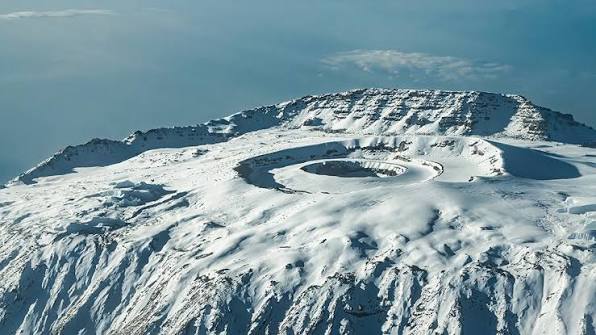
The Glaciers that make Kibo Crater rim, a gateway to Uhuru Peak
The Kibo Crater Rim is one of the most iconic and geologically significant features of Mount Kilimanjaro. Forming the upper edge of Kibo, the highest of the mountain’s three volcanic cones, the crater rim encircles the dormant volcanic crater near the summit and serves as the gateway to Uhuru Peak, Africa’s highest point at 5,895 meters (19,341 feet). For climbers, reaching the crater rim is one of the defining moments of the Kilimanjaro expedition, representing the culmination of days of trekking and the final stage before standing on the “Roof of Africa.”
Renowned for its dramatic volcanic landscape, towering glaciers, and breathtaking panoramic views, the Kibo Crater Rim offers a unique combination of natural beauty and geological history. From its rugged volcanic formations to its ancient ice fields, the rim provides an unforgettable experience that is both physically demanding and immensely rewarding.
Geological Formation
Mount Kilimanjaro is composed of three volcanic cones: Shira, Mawenzi, and Kibo. Of these, Kibo is the youngest and highest, rising to 5,895 meters above sea level. Although Kibo has not erupted in recorded history, it is classified as a dormant stratovolcano because geothermal activity remains beneath its surface. Fumaroles within the crater continue to release heat and volcanic gases, indicating that the volcano is inactive rather than extinct.
The Kibo Crater Rim was formed through hundreds of thousands of years of volcanic activity. Successive eruptions deposited layers of lava, ash, and volcanic rock, gradually building the mountain to its present elevation. Powerful explosive eruptions later created the summit crater, which measures approximately 2.5 kilometers (1.6 miles) in diameter.
At the center of the main crater lies the Ash Pit, a smaller volcanic depression that remains one of the few areas on the mountain where geothermal activity can still be observed. The crater itself is characterized by loose volcanic scree, ancient lava flows, glaciers, and exposed rock formations, creating one of Africa’s most extraordinary high-altitude landscapes.
Important Landmarks Along the Crater Rim
Several prominent landmarks are located along the Kibo Crater Rim, each representing an important milestone during the ascent to Uhuru Peak.
Gilman’s Point
Situated at 5,685 meters (18,652 feet) on the eastern edge of the crater rim, Gilman’s Point is reached by climbers ascending via the Marangu Route. After several hours of climbing steep volcanic scree from Kibo Hut, arriving at Gilman’s Point marks the first point where trekkers officially reach the crater rim.
Although some climbers conclude their ascent here due to fatigue or altitude-related symptoms, the majority continue along the rim toward Uhuru Peak. Depending on weather conditions and individual fitness, the journey from Gilman’s Point to the summit generally takes between one and two hours.
Stella Point
Located at 5,756 meters (18,885 feet) on the southern section of the crater rim, Stella Point is the primary access point for climbers ascending via the Machame, Lemosho, Shira, Umbwe, and Northern Circuit routes from Barafu Camp.
For many trekkers, Stella Point represents one of the most emotional moments of the expedition. After completing the steepest section of the climb, they are rewarded with spectacular sunrise views over the East African plains. From Stella Point, the trail becomes considerably less steep, allowing climbers to complete the final section to Uhuru Peak at a slower and more comfortable pace.
Uhuru Peak
Positioned on the western edge of the crater rim, Uhuru Peak stands at 5,895 meters (19,341 feet) and is the highest point on Mount Kilimanjaro and the African continent. The summit is marked by the famous wooden sign that welcomes climbers to the “Roof of Africa.”
Standing at Uhuru Peak offers an extraordinary reward for the effort required to reach it. On clear mornings, climbers enjoy panoramic views across the crater, the surrounding glaciers, the volcanic plains below, and the distant landscapes of Tanzania and Kenya. For many, reaching Uhuru Peak is the realization of a lifelong dream and one of the greatest achievements in adventure travel.
The Summit Experience
The ascent to the Kibo Crater Rim typically begins shortly before midnight from either Kibo Hut or Barafu Camp, depending on the chosen climbing route. Starting in darkness allows climbers to reach the summit around sunrise, when weather conditions are generally more stable and visibility is at its best.
The climb is intentionally slow, with guides maintaining a steady pace to conserve energy and help climbers adjust to the increasingly thin air. Temperatures frequently fall below -10°C (14°F), while oxygen levels at the summit are approximately half those found at sea level.
As dawn approaches, the first rays of sunlight illuminate Kilimanjaro’s glaciers, volcanic crater, and the vast East African plains stretching toward the horizon. Many climbers describe witnessing sunrise from the crater rim as the emotional highlight of the expedition, combining physical accomplishment with unforgettable natural beauty.
Once on the crater rim, the trail toward Uhuru Peak becomes less steep but remains physically demanding because of the altitude. The gradual walk across the rim provides numerous opportunities to appreciate the mountain’s unique geological features before reaching the summit.
Glaciers and Ice Fields
The Kibo Crater Rim is home to some of Mount Kilimanjaro‘s last remaining glaciers and permanent ice fields, including the Rebmann Glacier, the Furtwängler Glacier, and the Northern Ice Fields. These ancient ice formations have survived for thousands of years despite the mountain’s location only a few degrees south of the equator.
Over recent decades, however, scientific studies have documented a significant reduction in Kilimanjaro’s glaciers due to rising temperatures, reduced snowfall, and changing climatic conditions. Although the ice fields continue to shrink, they remain among the mountain’s most recognizable features and provide a striking visual contrast against the dark volcanic rock surrounding the crater.Challenges of Reaching the Crater Rim
Reaching the Kibo Crater Rim represents one of the most physically demanding stages of climbing Mount Kilimanjaro. The challenges are primarily related to altitude rather than technical difficulty.
Climbers must contend with significantly reduced oxygen levels, freezing temperatures, strong winds, loose volcanic scree, and accumulated fatigue after hiking throughout the night. These conditions can make even short distances feel physically exhausting.
Successful ascents depend on careful preparation, gradual acclimatization, maintaining a slow pace, staying well hydrated, and following the guidance of experienced mountain guides. Climbers who allow adequate time to adjust to the altitude generally enjoy a safer and more rewarding summit experience.
Why the Kibo Crater Rim Is So Remarkable?
The Kibo Crater Rim is far more than the final approach to Uhuru Peak—it is the geological heart of Mount Kilimanjaro and one of the continent’s most extraordinary natural landmarks. Formed by volcanic activity over hundreds of thousands of years, the rim showcases dramatic lava formations, ancient glaciers, volcanic craters, and breathtaking high-altitude scenery found nowhere else in Africa.
For climbers, reaching the crater rim symbolizes determination, endurance, and achievement. It is the moment when days of trekking culminate in panoramic views, dramatic landscapes, and the realization that the summit is within reach.
Whether admired for its geological significance, photographed for its spectacular scenery, or experienced as part of a successful summit ascent, the Kibo Crater Rim remains one of the defining highlights of any Mount Kilimanjaro expedition. It is a place where natural history, Africa Safari adventure, and personal accomplishment come together to create one of the world’s most memorable mountain experiences.